LIFEANO 给生活另一种可能
December 19-24, 2025 | A Journey Through Guangzhou: Guided by Professor Yuan Tengfei, Experience the Ancient and Modern Lingnan Culture.
December 19-24, 2025 | A Journey Through Guangzhou: Guided by Professor Yuan Tengfei, Experience the Ancient and Modern Lingnan Culture.
Out of stock
Couldn't load pickup availability
From the North to the South
Pack your bags
Join us to experience the vicissitudes of history.
Together with the top teacher
Embark on a journey to explore the culture of China: Guangzhou
Teacher in charge
Teacher Yuan Tengfei
Hailed by fans as "the best history teacher in history"
Guangzhou: One of China's most developed cities, it is also an ancient city with a history of thousands of years, containing many historical sites that have witnessed the turbulent moments of Chinese history.

Museum of the Western Han Dynasty Nanyue King's Tomb
The Museum of the Western Han Dynasty Nanyue King is the tomb of Zhao Mo, the second king of the Nanyue Kingdom, discovered in 1983. It is the largest and only painted stone chamber tomb from the Han Dynasty discovered in the Lingnan region. More than 10,000 artifacts were unearthed from the tomb, including the gold seal of Emperor Wen, a jade horn cup, a tiger-shaped tally with inlaid gold inscription, a printed copper plate mold, and a flat glass copper plaque ornament. These artifacts have significant historical, scientific, and artistic value, and collectively reflect various aspects of the politics, economy, and culture of Lingnan two thousand years ago.

Museum of the Palace of the King of Nanyue
The Museum of the Palace of the Southern Yue Kings displays the ruins and artifacts of the royal palace and gardens of the Southern Yue Kings from two thousand years ago. It also features video recordings and guided tours to help visitors understand the archaeological excavation process, admire the precious unearthed artifacts, and even experience the historical information firsthand at the archaeological site.

Huanghuagang Seventy-Two Martyrs Cemetery
Huanghuagang was originally named Honghuagang. After burying the martyrs, Pan Dawei felt that "Honghua" (red flower) was not as powerful and beautiful as "Huanghua" (yellow flower). Therefore, in reports introducing the martyrs' burial, he changed Honghuagang to Huanghuagang. The name has been used ever since.
In 1912, the Guangzhou Military Government allocated 100,000 yuan to build a martyrs' cemetery on the original cemetery site. Dr. Sun Yat-sen personally planted pine trees and inscribed the four characters "浩然正气" (meaning "righteous spirit") for the cemetery. The cemetery was expanded several times afterward. The cemetery contains the remains of 86 martyrs whose names and deeds are documented.

Liurong Temple
Liurong Temple is an ancient temple in Guangzhou with a long history and a reputation both at home and abroad. The temple boasts a magnificent pagoda, lush trees, and a wealth of cultural relics, bearing the footprints of many famous figures throughout history. Liurong Temple is named after the inscription written by Su Dongpo for the temple. It is considered one of the four major Buddhist temples in Guangzhou, along with Guangxiao Temple, Hualin Temple, and Haitong Temple.

Southern Han Dynasty Mausoleum Museum
The Southern Han Dynasty Mausoleums Museum is a museum built based on archaeological findings. It is mainly divided into three parts: "The Great Han Kingdom of Lingnan," "The Capital City of Xingwang Palace," and "The Three Mausoleums Discovered Through Archaeology." Through archaeological discoveries and existing cultural relics and historical sites of the Southern Han Dynasty, the museum comprehensively and three-dimensionally presents the history and culture of the Southern Han Kingdom during the Five Dynasties period to the public using physical objects, pictures, videos, and multimedia interactive methods.
Although it is named the "Museum of the Southern Han Tombs", its collection of archaeological artifacts is not limited to those unearthed from the Southern Han Tombs, but also includes archaeological discoveries from various parts of Guangzhou in recent years.

Former site of Whampoa Military Academy
The former site of the Whampoa Military Academy was originally the school buildings of a primary school for the army and a naval academy during the Qing Dynasty. On June 16, 1924, with the help of Soviet advisors, Sun Yat-sen founded a school to train military officers, named the "Chinese Nationalist Party Army Officer School," later renamed the "Republic of China Army Officer School." Because it is located on Changzhou Island in Huangpu, it is commonly known as the Whampoa Military Academy.

Weiyuan Fort
Weiyuan Fort is located at the foot of Beiwu Mountain in Chuanbiyang, at the mouth of the Pearl River in China, in the center of the rocks on the beach in front of Nanshan Fort. Together with Zhenyuan and Jingyuan Forts, it forms a "品" (pin) shape, and together with Hengdang, Yong'an, and Gonggu Forts, it constitutes the second line of defense for the Humen coastline during the Opium War. Iron chains and wooden stakes were anchored in the water between the forts to obstruct enemy ships; the forts' firepower was interwoven, controlling the sea and forming a formidable position on the narrow river. Weiyuan Fort housed a total of 40 cannons and was the site of a bloody battle fought by Li Tingyu, the General of Chaozhou, and his troops in January and February of 1841; remnants of this battle still exist.

Shajiao Fort
During the Opium War, Shajiao Fort and Dajiao Fort were the first line of defense at the Humen estuary. In the war against foreign aggression, Shajiao Fort witnessed many heroic deeds and tragic stories.

Opium War Museum
The Opium War Museum, located in Humen, Dongguan City, Guangdong Province, is a specialized museum that combines commemoration and historical sites. The Lin Zexu Opium Destruction Pool and the Humen Fort site in the museum are national key cultural relics protection units and historical witnesses to the Opium War.

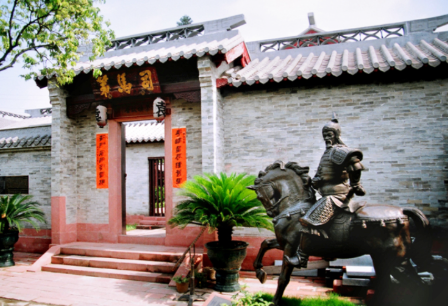
Yuan Chonghuan's Former Residence
The Yuan Chonghuan Memorial Park is situated beside the Dongjiang River, overlooking pomegranate blossoms, with shimmering lake and willow trees creating a picturesque scene. Attractions include a memorial archway, a stone statue of Yuan Chonghuan, the Yuan Chonghuan Shrine, a biographical relief of Yuan Chonghuan, his former residence, a cenotaph, and the Sanjie Temple.
Registration Instructions
Assembly/Dissolution
●Meet in Guangzhou on Friday, December 19, 2025, and depart in Guangzhou on Wednesday, December 24. Please make appropriate arrangements for your itinerary before and after the meeting.
Precautions
●Our customer service will contact you one week before the group buy starts after you register. Please keep your WeChat and phone accessible.
●Children under 6 years old are not recommended to participate. Minors aged 6-14 and seniors over 70 years old must be accompanied by a family member to register.
Activity Fees
●The fee includes: meals, accommodation, transportation, and lectures by the instructor from the time of assembly until the end of the assembly period;
●The price does not include: round-trip transportation before and after the meeting, and other expenses not listed.
Worry-free refund policy
●If the event is cancelled due to reasons attributable to the organizer, all fees will be refunded.
●If the event is cancelled due to force majeure, all unused fees will be refunded;
●If you are unable to attend the event due to personal reasons, no refund will be given (spot is transferable). Please do not bid if you mind. Thank you for your understanding.