LIFEANO 给生活另一种可能
November 16, 2025 | Exploring Beijing: A visit to the White Pagoda Temple and the Temple of Emperors of Past Dynasties with Mr. Yuan Tengfei, who will tell you the stories behind these ancient temples.
November 16, 2025 | Exploring Beijing: A visit to the White Pagoda Temple and the Temple of Emperors of Past Dynasties with Mr. Yuan Tengfei, who will tell you the stories behind these ancient temples.
Out of stock
Couldn't load pickup availability
As the saying goes, "The White Pagoda casts no shadow, yet the pagoda casts no shadow."
The White Pagoda Temple has no shadow?
Is it a decline in morality?
Or is it the distortion of human nature?
This will definitely make for a filler episode of "Approaching Science".
Is there a specific order to the arrangement of the temples dedicated to emperors throughout history?
Why were some emperors refused entry to temples?
There are countless stories in Beijing.
This time, teacher Yuan Tengfei will guide everyone to experience...
The various legends of the White Pagoda Temple and the history behind the Temple of Emperors of Past Dynasties
Teacher in charge
Teacher Yuan Tengfei
Hailed by fans as "the best history teacher in history"
White Pagoda Temple (Miaoying Temple)

Photo: Taken by a fan following the trail
During the Liao Dynasty, Miaoying Temple was located in the northern suburbs of Nanjing City. As early as the second year of the Shouchang era of the Liao Dynasty (1096), a pagoda was built to enshrine Buddhist relics, as well as incense pagodas, Buddhist scriptures and other Buddhist sacred objects. It was later destroyed by war.
In 1271, the eighth year of the Zhiyuan era of the Yuan Dynasty, Kublai Khan ordered the reconstruction of a Lamaist pagoda on the site of the Liao Pagoda. In 1279, Kublai Khan further ordered the construction of the "Great Sage Longevity and Peace Temple" centered around the pagoda. Historical records state that the temple's area was determined by the range of an arrow shot from the top of the pagoda, covering 160,000 square meters.
However, based on the estimated locations of streets and surrounding buildings at that time, the north-south extent of the White Pagoda Temple then and today is basically the same. As an important project in the construction of the Yuan Dynasty's capital, Dadu, the temple was completed in the 25th year of the Zhiyuan era (1288). Because it was located west of Dadu, it was also known as the "Western Garden." From then on, it became the royal temple of the Yuan Dynasty, as well as a place for officials to practice rituals and for translating and printing Mongolian and Uyghur Buddhist scriptures.
In 1900, the Eight-Nation Alliance occupied Beijing and stormed into Miaoying Temple, looting its ritual implements and offerings. In the mid-to-late Qing Dynasty, the monks rented out the side halls and open spaces, which gradually evolved into one of Beijing's famous temple fairs. During festivals, the temple became extremely lively, leading to the custom of "walking past the White Pagoda on the eighth day of the eighth lunar month" in Beijing.
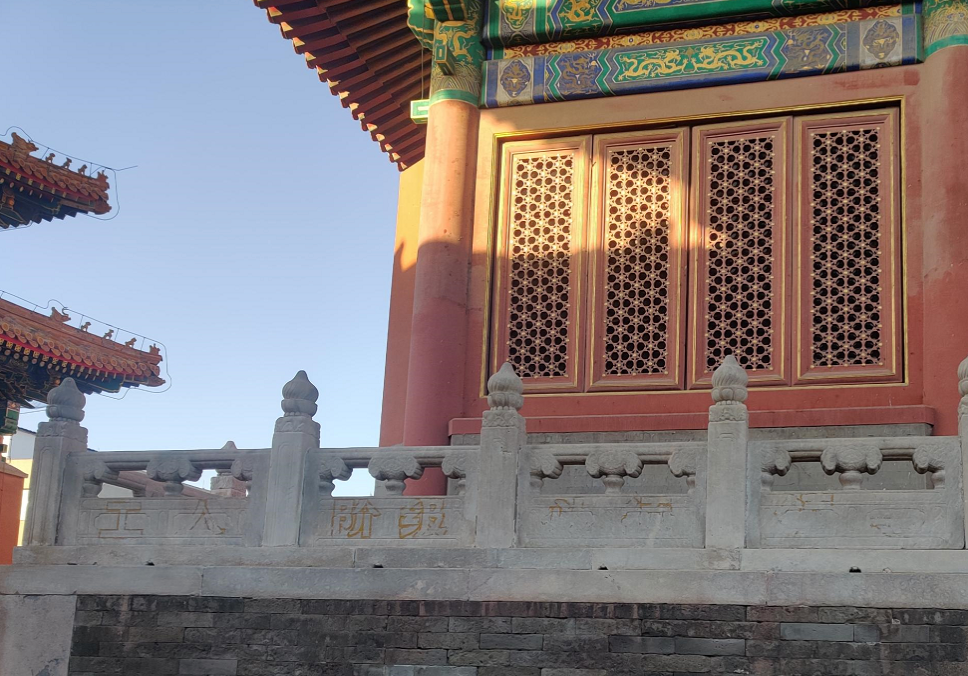
Temple of Emperors of Past Dynasties

Photo: Taken by a fan following the trail
The Temple of Emperors of Past Dynasties was first built in the ninth year of the Jiajing reign of the Ming Dynasty (1530). It was the place where emperors of the Ming and Qing dynasties worshipped their ancestors. Its political status was equal to that of the Imperial Ancestral Temple and the Temple of Confucius, and together they were known as the three major royal temples in Beijing during the Ming and Qing dynasties. The Chinese have had the custom of worshipping their ancestors since ancient times. The Three Sovereigns have always been regarded as the ancestors of the Chinese people and were admired by emperors of past dynasties. The emperors of previous dynasties were role models for later generations to learn from and emulate, so they were also worshipped.
As early as the pre-Qin period, the Book of Rites (specifically the section on sacrificial rites) recorded that all those who "apply laws to the people," "serve diligently to the death," "stabilize the country through hard work," "are able to ward off major disasters," and "are able to defend against major calamities" should be worshipped. It was believed that Fuxi, Yandi, Huangdi, Yao, Shun, Yu, Tang, King Wen of Zhou, and King Wu of Zhou were important representatives of these figures.
After the Qin and Han dynasties, the worship of the Three Sovereigns and Five Emperors and emperors of past dynasties continuously evolved and changed: it progressed from tomb worship to temple worship, from individual figure worship to series of figure worship, from scattered individual worship to concentrated group worship, from worshipping founding emperors to worshipping emperors who maintained their dynasties, from worshipping emperors of the Han Chinese people to worshipping emperors of multiple ethnic groups, and from worshipping the emperor himself to having virtuous ministers as accompanying figures. Initially, Zhu Yuanzhang, the founding emperor of the Ming Dynasty, determined that 16 emperors would be worshipped, and after the Shunzhi Emperor of the Qing Dynasty established Beijing as the capital, this number was increased to 25. The Kangxi, Yongzheng, and Qianlong emperors all attached great importance to the temples dedicated to emperors of past dynasties. Kangxi once issued an edict: except for emperors who were killed for their tyranny or those whose dynasties fell, the memorial tablets of all emperors who had ever reigned should be erected in temples.
Emperor Qianlong went further, proposing the idea that "the lineage of Chinese rule must never be broken," and selecting emperors from dynasties not mentioned in the temple to be enshrined. After several adjustments, the final number of emperors to be worshipped was determined to be 188.
Registration Instructions
Event Time
●November 16, 2025 (Sunday)
Event Location
●Beijing - White Pagoda Temple + Temple of Emperors of Past Dynasties
*The specific meeting point will be sent to your mobile phone by customer service staff about three days before the group starts, after the group is formed. Please pay attention to the message notification.
*After successful registration, you must proceed to the meeting point on your own to participate in the activity. The group will disperse at the end of the activity.
Number of participants
● No more than 30 people
●Children under 6 years old are not recommended to participate. Minors aged 6-12 years old must be accompanied by a guardian.
●Refuse last-minute, unannounced arrivals
Activity Fees
●The fee includes: expert lectures; full-time tour leader service; audio guide.
●The price does not include: round-trip travel before and after the meeting; other personal expenses.
*If tickets are required for the event, please make a reservation through our official WeChat account.
Worry-free refund policy
●If the event cannot be held due to reasons attributable to the organizer or force majeure, you will be refunded the full amount (your spot can be reserved if the event is postponed).
●Apart from the above, once registration is successful, no fees will be refunded (registration is transferable);
●Children under 6 years old cannot participate in this activity, and children aged 6-12 years old cannot participate in the activity alone.
●After successful registration, we will have someone contact you to discuss the follow-up matters. Please keep your registered mobile phone number accessible.
*Note: To ensure the sustainability of the offline event, audio and video recording is strictly prohibited throughout the entire event. Thank you for your cooperation and understanding.
*Note: Once registration is successful, fees are non-refundable and non-exchangeable. Please do not register if you mind.