LIFEANO 给生活另一种可能
November 15, 2025 | Exploring Beijing: Teacher Yuan Tengfei tells you the history behind the Yonghe Temple and the Confucius Temple and Imperial College.
November 15, 2025 | Exploring Beijing: Teacher Yuan Tengfei tells you the history behind the Yonghe Temple and the Confucius Temple and Imperial College.
Out of stock
Couldn't load pickup availability
This time, teacher Yuan Tengfei
We will be taken to the Yonghe Temple, which is known as the "Land of Hidden Dragons".
In addition, it will take us to the Ming and Qing Dynasties.
The highest institution of learning and educational administration
"Temple of Confucius & Imperial College"
Exploring the Chinese Imperial Examination System that lasted for over 1,200 years
Understanding how it influenced ancient Chinese history
Remembering the glorious life of Confucius, the "Supreme Sage and Teacher"
And the one he founded
Confucianism, which has influenced Chinese history
Teacher in charge
Teacher Yuan Tengfei
Hailed by fans as "the best history teacher in history"
The Temple of Confucius and the Imperial College in Beijing were first built in the Yuan Dynasty and are separated by only a wall. Following the ancient system of "temple on the left and school on the right," they served as the place where the emperor worshipped Confucius and the highest institution of learning in the central government, respectively. Professor Yuan Tengfei will take us on a journey through these two ancient architectural complexes, telling us about the history of the ancient Chinese imperial examination system and the great life of Confucius.
The Imperial Examination System in Ancient China

During the Five Dynasties period, Wang Dingbao recorded the following story in his book "Tang Zhiyan": Emperor Taizong of Tang, Li Shimin, once went to inspect the Imperial Censorate and saw the newly promoted Jinshi (successful candidates in the highest imperial examinations) filing out. He proudly said, "The heroes of the world are now in my grasp!"
The "Gou" mentioned by Emperor Taizong refers to the imperial examination system that originated in the Sui Dynasty.
It was precisely because of the imperial examination system that the social mobility in China underwent a fundamental change. Talented individuals from the lower classes without family backgrounds could use the imperial examinations to achieve upward social mobility, change their life trajectories, and even influence the course of history to some extent.
What was the historical context in which China's imperial examination system was formed? What major changes did it undergo during its more than 1,000 years of development? And under what historical circumstances was the imperial examination system abolished in 1905?
Ancient Chinese Official Selection System

The Song Dynasty poet Wang Zhu wrote in his "Poems for Prodigies": "In the morning, a peasant; in the evening, a courtier in the emperor's palace." Through the imperial examination system, many talented individuals from humble backgrounds in Chinese history achieved upward social mobility and entered the ruling bureaucracy.
To some extent, the imperial examination merely provided a "qualification certificate" for talented individuals to enter the bureaucratic system. To become a local official responsible for guarding the territory or a high-ranking official in the capital who served the emperor, another complex system of official selection was required.
Therefore, passing the imperial examination with top honors does not necessarily guarantee a high-ranking official position. So how did the official selection system established by the Chinese ruling class evolve from nothing to something, and from simple to complex? What are its advantages and limitations?
Confucius and Confucianism

In China, the phrase "Supreme Sage and Teacher" specifically refers to Confucius, which shows the high esteem people have for him.
Since Emperor Wu of Han "dismissed all other schools of thought and exclusively honored Confucianism," Confucius and the Confucianism he represented have influenced China for over 2,000 years. However, it would be a grave mistake to view Confucius and his Confucianism merely as a tool for the ruling class to control people.
Although Confucius transmitted knowledge but did not create new works, he left behind his valuable intellectual legacy for posterity in other ways. What a legendary life Confucius led! Why didn't he write books and biographies like other great scholars? When did the complete system of Confucianism truly take shape?
Yonghe Temple was first built in the 33rd year of the Kangxi Emperor's reign (1694) as a residence bestowed upon his fourth son, Yinzhen, and is therefore also known as the Yongqin Prince's Mansion.

In 1711, the fiftieth year of the Kangxi Emperor's reign, Aisin-Gioro Hongli was born in the "Ruyi Room" of the East Study of the Yong Prince's Mansion. In 1735, the thirteenth year of the Yongzheng Emperor's reign, the Yongzheng Emperor passed away, and his coffin was temporarily placed here. In 1744, the ninth year of the Qianlong Emperor's reign, the Yonghe Temple was converted into a Lama temple, and a special minister was appointed to manage its affairs, making it the center of the Qing government's administration of Tibetan Buddhist affairs throughout the country.
Emperor Yongzheng's life was closely connected with this place, and Emperor Qianlong was born here. Both emperors who had a great influence on the Qing Dynasty were associated with it, so it adopted the same architectural specifications as the Forbidden City Palace - red walls and yellow tiles.
Over the past 300 years since its construction, the Yonghe Temple has undergone several important periods, evolving from a prince's residence to an imperial palace and then to a Lama temple. The "Tracing the Footsteps" segment will recount some historical events within the Yonghe Temple that are unfamiliar to most but had a profound impact on the Qing Dynasty.
The Development and Evolution of Tibetan Buddhism

Buddhism originated in what is now India and has developed into many schools as it spread outwards. Tibetan Buddhism is one of the schools with a great influence and wide reach.
It is generally believed that Buddhism was introduced to the Central Plains from India via the Western Regions during the late Western Han Dynasty, the Xin Dynasty, and the early Eastern Han Dynasty. After more than a thousand years of development, it formed the Han Chinese Buddhist school.
The development of Tibetan Buddhism can be traced back to the 7th century AD, when Songtsen Gampo, the supreme ruler of the Tubo Kingdom, married Princess Bhrikuti from Nepal and Princess Wencheng from the Tang Dynasty. The two princesses brought with them life-size statues of Shakyamuni Buddha at ages 8 and 12, respectively, as well as a large number of Buddhist scriptures. Influenced by the two princesses, Songtsen Gampo converted to Buddhism and built the Jokhang and Ramoche temples.
By the mid-8th century, Buddhism had been introduced directly from India to Tibet. Tibetan Buddhism formally took shape in the latter half of the 10th century. It began to spread to Mongolia in the mid-13th century.
Over the next 300 years, various sects emerged, each with its own distinct characteristics, and most adhered to the Tantric school of Buddhism. For example, the Dalai Lama and the Panchen Lama are the two major living Buddha systems of the Gelug school (Yellow Hat sect) in Tibetan Buddhism. The Tibetan Buddhist community believes that the Dalai Lama is the incarnation of Avalokiteshvara, also known as the "Joyful Sangha Buddha," and the Panchen Lama is the incarnation of Amitabha Buddha, also known as the "Moonlight Buddha."
The relationship between the Qing imperial family and Tibetan Buddhism

Can you recognize who's sitting in the center of the picture above? That's right, it's the Qianlong Emperor. Like his father, he also loves cosplay.
In this "Thangka of Emperor Qianlong in Buddhist Attire" (partial) currently housed in the Palace Museum, he cosplayed as a Tibetan Buddhist monk wearing a pandita hat (pandita means scholar), dressed in monastic robes, with his right hand in the teaching mudra and his left hand holding a dharma wheel, sitting cross-legged on a lotus throne.
The Jianzhou Jurchens, who originated from the Changbai Mountains and the Heilongjiang River region, originally practiced Shamanism. However, after Huang Taiji changed the name of the Jurchens to Manchus and eventually ruled the Central Plains, their religious beliefs changed.
Ultimately, the Qing dynasty imperial family honored the Gelug school (Yellow Hat sect) of Tibetan Buddhism as the state religion and gave it great importance in various aspects, including politics and economics. For example, Huangsi Street, which is still well-known in Beijing today, gets its name from the residence built nearby during the Shunzhi period for the Fifth Dalai Lama.
However, did the Qing rulers truly value Tibetan Buddhism because they were captivated by its religious allure? Clearly, political motives played a more significant role. Throughout history, how many emperors have not used religion as a tool to consolidate their rule?
The system of peerage inheritance and the distribution of princely residences in the Qing Dynasty

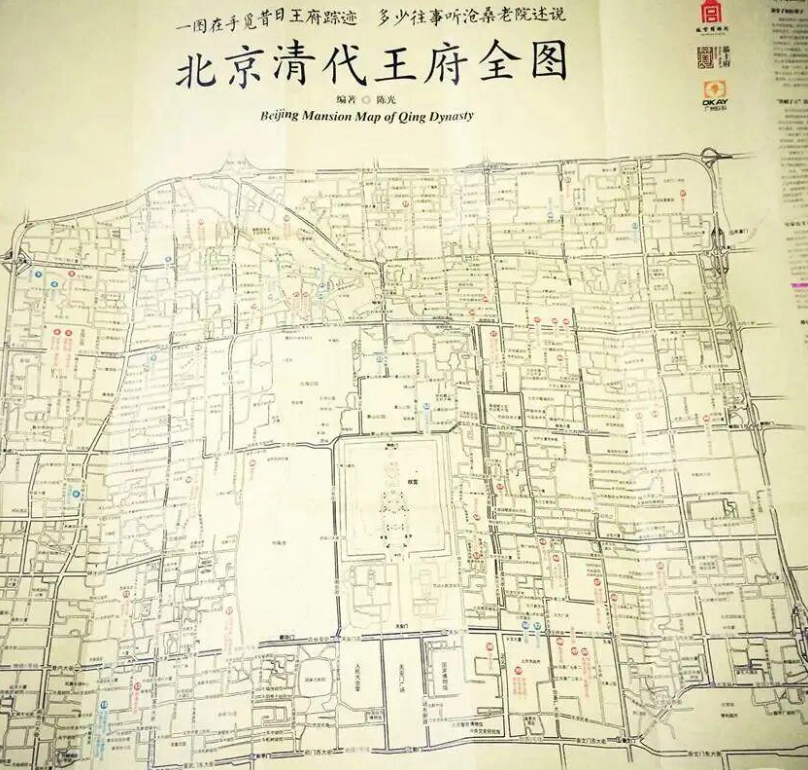
The vast city of Beijing is dotted with numerous princely mansions, among which the famous ones include the Prince Gong's Mansion near Shichahai and the Zheng Prince's Mansion, a notorious "haunted house" that frequently appears in various urban legends.
Most of the princely mansions in Beijing today originated from the Qing Dynasty. Unlike the Ming Dynasty, which implemented a system of vassal states, princes were granted the title of prince and had to go to their fiefdoms, where they would build mansions.
However, the Qing Dynasty was different. Basically, all princes had to live in the capital and could not leave the capital without special assignment. So, in order to provide these princes with places to live, it was natural to build palaces for them.
At the same time, there were the so-called "Eight Iron-Cap Princes" in the Qing Dynasty. They were granted the title of Prince from the beginning of the Qing Dynasty because of their outstanding contributions to the founding of the country. Their titles were hereditary and could not be changed. So from the first generation of Iron-Cap Princes to the last generation, their residences continued to exist.
Every dynasty had its own system of peerage inheritance, which was crucial to the stability of the dynasty. The system aimed to prevent the granting and inheritance of peerage from becoming too widespread, while also avoiding excessive harshness towards meritorious officials that could lead to internal conflicts.
Therefore, the system of succession to nobility greatly tested the wisdom of the rulers. So how did the Qing Dynasty solve this problem? What stories are associated with the princely mansions that remained in Beijing during the Qing Dynasty?
Registration Instructions
Event Time
●November 15, 2025 (Saturday)
Event Location
●Beijing - Yonghe Temple + Confucius Temple and Imperial College Museum
*The specific meeting point will be sent to your mobile phone by customer service staff about three days before the group starts, after the group is formed. Please pay attention to the message notification.
*After successful registration, you must proceed to the meeting point on your own to participate in the activity. The group will disperse at the end of the activity.
Number of participants
●No more than 40 people
●Children under 6 years old are not recommended to participate. Minors aged 6-14 must be accompanied by a guardian.
●Refuse last-minute, unannounced arrivals
Activity Fees
●The fee includes: expert lectures; full-time tour leader service; audio guide.
●The price does not include: entrance fees to attractions, round-trip transportation before and after the meeting; and other personal expenses.
*If tickets are required for the event, please make a reservation through the official WeChat account.
Worry-free refund policy
●If the event cannot be held due to reasons attributable to the organizer or force majeure, you will be refunded the full amount (your spot can be reserved if the event is postponed).
●Apart from the above, once registration is successful, no fees will be refunded (registration is transferable);
●Children under 6 years old cannot participate in this activity, and children aged 6-14 cannot participate alone.
●After successful registration, customer service staff will send the notification to your mobile phone about three days before the group purchase starts. Please pay attention to the notification.
*Note: To ensure the smooth running of the offline event, audio and video recording is strictly prohibited throughout the entire event. Thank you for your cooperation and understanding.
*Note: Once registration is successful, fees are non-refundable and non-exchangeable. Please do not register if you mind.